
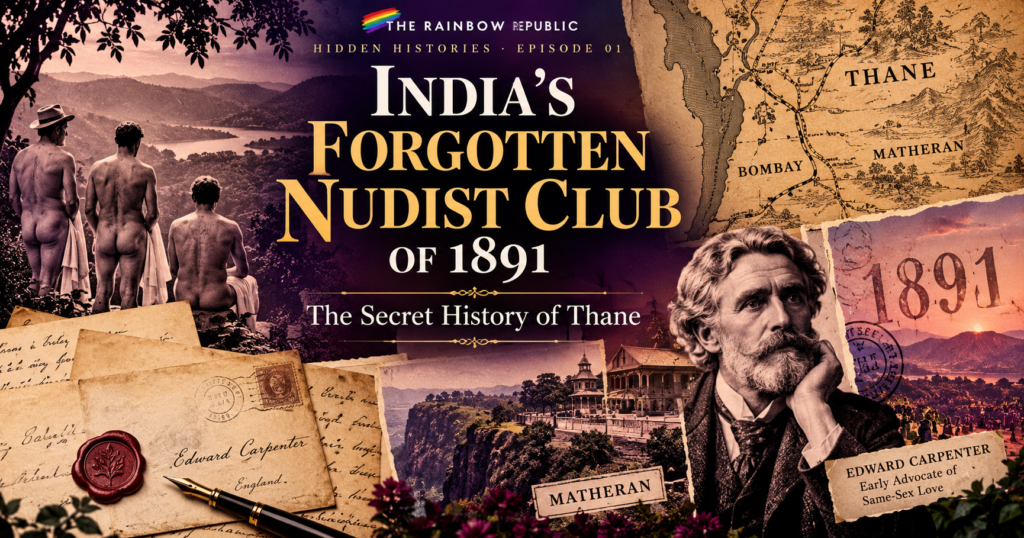
India’s Forgotten Nudist Club of 1891
A colonial judge, two brothers, and letters to an early advocate of same-sex love: the little-known story of a private naturist circle in the Bombay Presidency.
In 1891, when much of the world was governed by rigid Victorian conventions, an unusual experiment in social nudity was taking shape in the Bombay Presidency. It involved just three men, private gatherings, and an extraordinary name: the Fellowship of the Naked Trust.
Its story is connected to Thane, Matheran and the area around Tulsi Lake. But what makes it especially intriguing is a trail of correspondence with Edward Carpenter, a British writer and reformer who would become an important early voice in the history of same-sex love.
This is not evidence of a nineteenth-century LGBTQ+ club in India. It is something subtler: a glimpse into how ideas about the body, privacy, convention and personal freedom circulated across the British Empire.
Three men and a very unusual fellowship
According to historical reporting based on correspondence from the 1890s, the Fellowship was founded by Charles Edward Gordon Crawford, a British colonial judge, together with brothers Andrew and Kellogg Calderwood. Their project was not a public beach, a mass movement or a commercial resort. It appears to have been a tiny, private circle devoted to social nudity.
The setting matters. The Bombay Presidency was a colonial society shaped by unequal power, racial hierarchies and competing ideas of respectability. The men involved were British residents, not representatives of an indigenous Indian naturist movement. Calling the Fellowship an example of “ancient Indian acceptance” would distort its origins.
Why Thane, Matheran and Tulsi Lake appear in the story
Newspaper accounts link the Fellowship’s activities to locations in and around the Bombay region, including Thane, Matheran and Tulsi Lake. These places provided distance from the scrutiny of everyday urban life, but the precise details of each gathering remain limited in the publicly reported record.
It is tempting to imagine a large secret colony hidden in the hills. The evidence does not justify that image. What we can discuss with more confidence is the existence of an unusually named fellowship and the correspondence through which its activities became known.
The letters that kept the story alive
The story attracted renewed attention when journalists reported on a small collection of letters associated with Crawford and Edward Carpenter. These letters, dated between 1891 and 1892, were described as important clues to the Fellowship’s existence and philosophy.
For historians, private correspondence can be valuable precisely because it records ideas and activities that never became public institutions. Yet letters also have limits: they capture what particular writers chose to say, not necessarily a complete or independently verified account of every event.
1891: The Fellowship of the Naked Trust is reported to have formed in the Bombay Presidency.
1891–1892: Correspondence associated with Crawford and Carpenter provides a historical trail.
1908: Carpenter publishes The Intermediate Sex, a significant work in the early history of writing about same-sex love.
Much later: Newspaper investigations bring the Fellowship back into public conversation.
Edward Carpenter: the unexpected queer-history connection
Edward Carpenter (1844–1929) was an English socialist writer, poet and reformer. He wrote openly, for his era, about same-sex affection and relationships, and his work contributed to a language of sexual freedom before modern LGBTQ+ movements existed in their current form.
His connection to the Fellowship is intellectual and documentary: he corresponded with Crawford. Carpenter should not be presented as a confirmed member of the Thane-area group, and the existence of their correspondence does not establish that the Fellowship itself was a queer organisation.
Still, the link is meaningful. It places a small experiment in bodily freedom within a wider world of reformist thinking, where questions about dress, nature, social restrictions and intimate life could overlap without being identical.
Not every story about freedom of the body is a queer story. But some of those histories reveal the same enduring question: who gets to define what is respectable?
Naturism is not the same as sexuality
Naturism generally concerns non-sexual social nudity, often connected to ideas of nature, health or freedom from clothing conventions. Sexual orientation concerns patterns of romantic or sexual attraction. Gender identity concerns a person’s experience of gender. These are distinct concepts.
Conflating them can sexualise naturism unnecessarily and misrepresent LGBTQ+ history. The Rainbow Republic’s interest in this episode is not to claim that the club was gay, but to explore the ways social norms shape which bodies, identities and expressions are accepted or stigmatised.
Was it really the world’s first nudist colony?
The phrase makes a powerful headline, but history rarely offers such tidy superlatives. Practices involving communal nudity existed in many cultures long before 1891, while the beginnings of organised modern naturism depend on how historians define a club, movement or colony.
There is also a difference between a three-person fellowship and a residential colony. Without a comprehensive comparison with other early groups, “world’s first” is best treated as a reported claim rather than an established fact.
A more accurate conclusion is compelling enough: an exceptionally early, little-known organised naturist circle was documented in colonial India, and its correspondence connected it to an influential figure in early queer intellectual history.
Why should we remember this in 2026?
Because history becomes poorer when it is reduced to familiar heroes, major institutions and neat categories. Small, strange, imperfectly documented stories can reveal how people challenged conventions long before those challenges had modern names.
They also invite harder questions. Who could afford to experiment with freedom under colonial rule? Whose experiences were recorded in archives, and whose were ignored? Why are certain forms of nonconformity remembered while others disappear?
For a contemporary LGBTQ+ platform, those questions matter. The value of this story is not in retroactively claiming its founders as queer icons. It is in tracing the complex history of privacy, respectability and autonomy, while remaining honest about what the sources do—and do not—prove.
Not established: That the group was LGBTQ+, that Carpenter was a member, that it was a permanent residential colony, or that it was unquestionably the first naturist group anywhere in the world.
The story is bigger than the headline
Perhaps the most fascinating part of the Fellowship of the Naked Trust is not the absence of clothes. It is the presence of a question that remains relevant more than 130 years later: how much of our private lives should society be allowed to control?
The Rainbow Republic will continue exploring overlooked histories with curiosity, context and care—especially where stories of identity, dignity and freedom meet.
Share this article with someone who loves forgotten Indian history, and tell us which overlooked story we should investigate next.
Sources and further reading
- Bangalore Mirror — “World’s first nudist colony was in Thane”. A retrospective account of the Fellowship and the historical correspondence.
- Mumbai Mirror — “World’s first nudist colony was in Thane and this man proved it”. The earlier reported investigation into the archival trail. Availability of the original URL may vary.
- Edward Carpenter, The Intermediate Sex (1908). Primary historical writing relevant to Carpenter’s ideas; it does not independently verify the Fellowship’s activities.
Editorial note: This article synthesises published historical reporting. The Rainbow Republic has not independently authenticated the original letters. Historical illustrations, if added, should be labelled as illustrations rather than archival photographs.
History has more than one story.
Explore overlooked histories, queer culture and conversations about identity with The Rainbow Republic.
Explore The Rainbow Republic →