
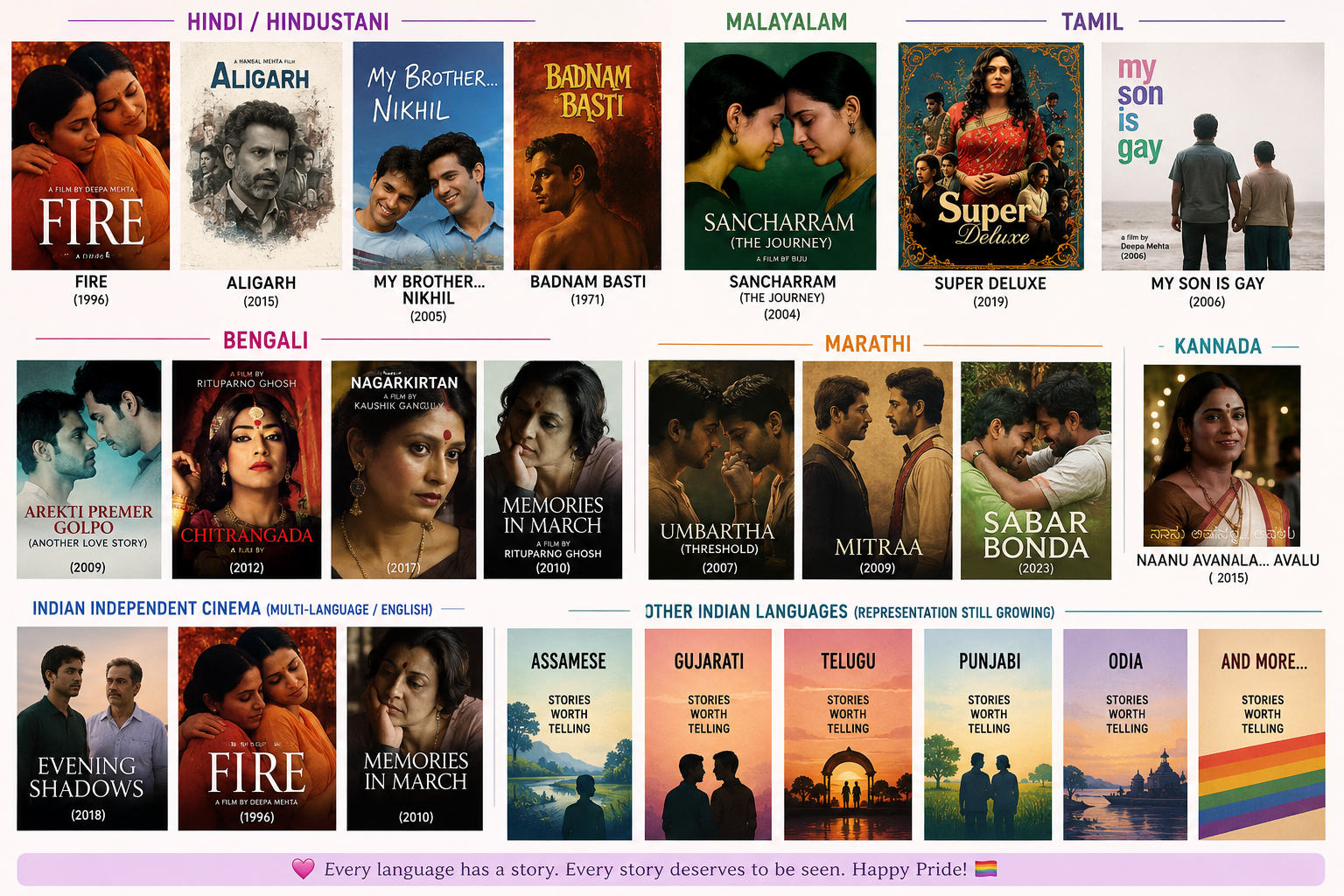
Top Queer Movies Across Indian Languages
Stories that made love, identity, silence, resistance and pride visible on Indian screens.
Indian cinema has always been more than entertainment. It is memory, rebellion, family argument, secret diary and public protest all at once. For queer Indians, movies have often done what society refused to do: they gave a face to longing, a voice to shame, a frame to desire, and sometimes, a home to people who were told they did not belong.
Queer stories in India did not arrive suddenly. They appeared quietly in coded glances, forbidden friendships, hidden grief and brave coming-out moments. Some films were ahead of their time, some were imperfect but important, and some became emotional lifelines for LGBTQIA+ viewers who had never seen themselves on screen before.
Fire, Aligarh, My Brother… Nikhil, Badnam Basti
Hindi-language queer cinema has had a difficult but historic journey. Badnam Basti is remembered as one of India’s earliest queer films, showing desire in a coded and poetic way long before mainstream cinema was ready.
Deepa Mehta’s Fire shook public conversation by placing female desire inside a domestic Indian setting. My Brother… Nikhil brought compassion to sexuality, stigma and HIV, while Aligarh remains one of the most haunting portraits of loneliness, dignity and institutional cruelty.
Sancharram / The Journey
Malayalam cinema gave Indian queer cinema one of its most tender lesbian love stories with Sancharram. Set in Kerala, the film follows two young women whose friendship grows into love in a world shaped by religion, family expectations and arranged marriage.
What makes the film powerful is its softness. It does not treat queer love as spectacle. It treats it as intimate, natural and deeply human.
Super Deluxe, My Son Is Gay
Tamil cinema has explored queer identity through both mainstream and independent spaces. Super Deluxe became widely discussed for Vijay Sethupathi’s portrayal of Shilpa, a trans woman returning to her family and facing rejection, humiliation and fragile acceptance.
My Son Is Gay focuses on a mother’s emotional journey after discovering her son’s sexuality. These films bring queer identity into the language of family, shame, love and understanding.
Arekti Premer Golpo, Chitrangada, Nagarkirtan, Memories in March
Bengali cinema has one of India’s richest queer film traditions, especially through the work and legacy of Rituparno Ghosh. Arekti Premer Golpo and Chitrangada explore gender performance, desire, art and identity with rare sensitivity.
Nagarkirtan brings the pain and poetry of trans identity into focus, while Memories in March tells the story of a mother discovering her late son’s relationship with another man.
Umbartha, Mitraa, Sabar Bonda
Marathi cinema has explored queer themes with subtlety and social awareness. Mitraa brought same-sex desire into a period setting with emotional restraint.
More recently, Sabar Bonda brought rural intimacy, grief and queer love into the spotlight, proving that queer tenderness belongs not only to cities but also to villages, small towns and ordinary homes.
Naanu Avanalla… Avalu
Kannada cinema’s Naanu Avanalla… Avalu is a landmark film about a trans woman’s life, struggle and search for dignity. Based on the life and writings of Living Smile Vidya, it follows a person assigned male at birth who embraces her womanhood despite rejection.
It matters because it centres a trans life not as a joke or side character, but as the emotional heart of the story.
Evening Shadows, Fire, Memories in March
Several Indian queer films have used English or mixed-language storytelling to reach wider festival and urban audiences. Evening Shadows is a tender coming-out story about a gay son and his mother.
These films remind us that queer cinema in India has often survived through festivals, community screenings, private recommendations and chosen-family networks.
Assamese, Gujarati, Telugu, Punjabi, Odia and More
In many Indian languages, queer cinema is still underrepresented or difficult to access. Assamese, Gujarati, Telugu, Punjabi, Odia, Bhojpuri, Konkani and other regional industries have powerful storytelling traditions, but openly LGBTQIA+ narratives remain limited.
This gap itself tells a story. Queer Indians exist in every language, every region, every religion, every caste and every family. Cinema still has a long way to go before every Indian language has its own full archive of queer love, identity, friendship and survival.
Why These Films Matter
Queer cinema is not only about representation. It is about correction. For years, LGBTQIA+ people were reduced to comic relief, villains, tragedy or silence. These films challenged that. They showed queer people as lovers, children, parents, artists, workers, believers, rebels and ordinary human beings.
Some of these films may feel dated today. Some may be debated for who got to tell the story, who played the role, and whether the community was represented with complete fairness. But they remain important because they opened doors.
The Rainbow Republic View
Indian queer cinema is not one story. It is many stories in many tongues. It is a Malayalam girl hiding her love, a Bengali mother understanding her son after death, a Kannada trans woman claiming her name, a Tamil family learning to see Shilpa, a Hindi professor fighting for dignity, and a Marathi love story proving that queer tenderness can bloom even in grief.
Every Indian language has words for love. Now cinema must find the courage to say them all.