
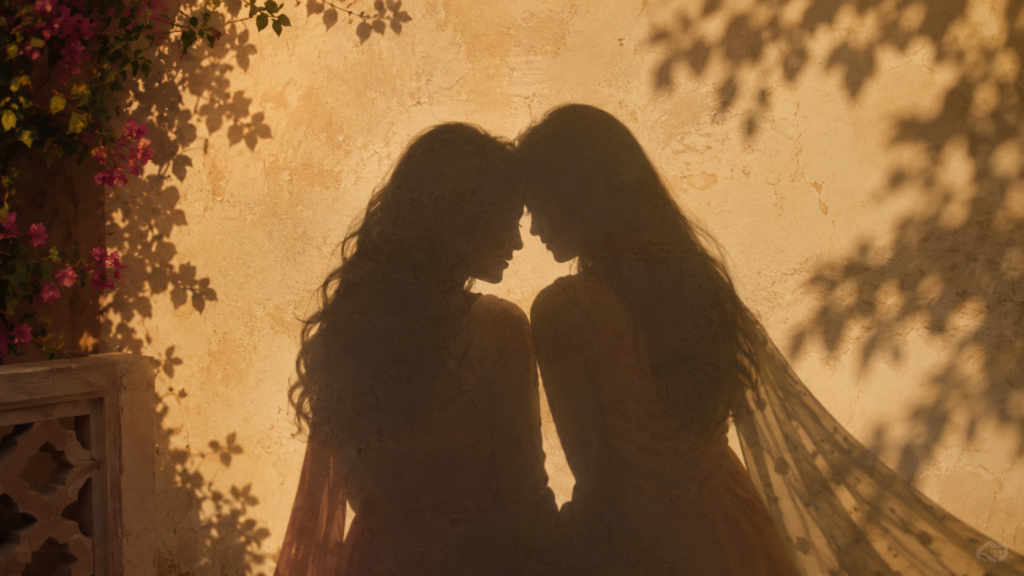
Two girls, one lane, and the long distance between a small town and the truth.
Madhopur was the kind of town where every lane carried two smells at once. Mornings smelled of wet earth and detergent foam drifting off the courtyards; evenings, of frying chilies and diesel from the last bus coughing past the bazaar. Behind the Hanuman temple ran a narrow lane where Tara Mishra and Mukti Gupta grew up facing each other from opposite houses — so close that if one family hung a bedsheet on the terrace, the other could name it by the patchwork of sunlight falling through the cloth.
They became friends before either of them knew what friendship was supposed to look like.
At eight, Tara was the quieter child — sharp elbows, large eyes, a pencil mark forever smudged on her wrist. Mukti was round-cheeked, loud, and permanently sticky with sugar, because her father’s mithai shop stood at the corner of the lane and she was always stealing warm boondi off the tray before it hardened into laddoos.
“Arre, wait,” Mukti would shout, chasing Tara home from school with her braids flying. “Half my guava for half your achar.”
“You already ate your tiffin,” Tara would say.
“That is separate. This is negotiation.”
They learned each other the way children do — not by introductions but by accumulation. Tara knew Mukti slept with one foot outside the bedsheet even in December, daring the cold to try something. Mukti knew Tara hated milk skin but loved the smell of cardamom in the second before anyone crushed it. At ten, they folded paper boats for the first monsoon and sent them down the flooded lane with such solemnity you’d have thought they were dispatching letters to another country.
Their mothers called them “the twins,” though they looked nothing alike. Tara’s mother taught Hindi at the government girls’ school and spoke in complete sentences even when furious. Mukti’s mother stitched blouses in a back room behind the sweet shop and kept pins clamped between her lips while she talked, so her scoldings came out soft and dangerous at once — a lullaby with a blade in it.
During festivals the two homes blurred into one long household. On Diwali afternoons Tara sat on the Gupta threshold rolling cotton wicks for diyas while sugar syrup hissed in kadhais the size of drums. On Holi mornings Mukti barged into Tara’s courtyard before sunrise, smeared dry pink powder across her cheeks, and shrieked, “Bura na mano!” before Tara had finished waking up. In summer they slept on separate charpais on the same terrace, under a sky cluttered with stars and electric wires, whispering until one mother or another yelled, “Bas karo, both of you. Sleep.”
The world began noticing them back.
It arrived in small corrections at first. Sit properly. Don’t run in the bazaar. Wear your dupatta. Come home before dark. Stop laughing so loudly near the paan shop. The lane that had once been simply theirs slowly filled with instructions, like a room being furnished against your will.
They started cycling to evening tuition together, past the grain market and the shuttered cinema hall with its peeling posters. Tara grew taller. Mukti’s voice settled into something warmer. Boys from the boys’ school began finding reasons to loiter near the stationery shop. One of them asked Tara for notes, and she came home flustered — not because he had spoken to her, but because Mukti had gone strangely quiet afterward.
That night on the terrace, Mukti said into the dark, “He asks everyone for notes. He is useless.”
Tara turned her face to the sky so Mukti wouldn’t see her smile. “I did not plan to marry him, pagal.”
Mukti said nothing for a long moment. Then, very softly: “Achha.”
It should have been a small exchange. Tara remembered it for years anyway — the way people remember the first taste of rain on a dry day, startled that something so ordinary could feel like an event.
At sixteen, a news anchor on Tara’s living-room television spoke in rapid Hindi-English about a judgment from Delhi — the Supreme Court, Section 377, dignity, something old struck down. Tara’s father had the volume too loud, as always. Mukti, cross-legged on the floor with a bowl of murmura, understood none of it.
“What is it?” Tara asked.
Her father cleared his throat. “Some court matter.”
“About what?”
“About… city issues.” He turned the volume down. “Not for children.”
Tara’s mother, who usually explained everything, only said, “Eat before the tea gets cold.”
On the walk to tuition, Tara repeated the number to herself. Three-seven-seven. Mukti laughed at the seriousness on her face.
“You study law now?”
“No. Just thinking.”
“Dangerous habit.”
They let the number go. Or perhaps it never really left — perhaps it settled somewhere inside them like a seed waiting out a season it didn’t yet trust.
By nineteen, the town had begun speaking to them in matrimonial language.
Not directly, at first. A visiting aunt would say, “Tara draws so well, but after marriage where is the time for all this?” A customer at the sweet shop would ask Mukti’s mother whether she’d “seen any good boy.” There was always someone’s niece engaged, someone’s cousin dispatched to Indore, someone’s daughter “too educated now, difficult to place” — as though education were a stain that widened with washing.
Tara was accepted into a design course in Mumbai the same week Mukti was offered a training position at a bakery chain through a cousin. They sat behind the temple wall with their admission forms spread across Tara’s dupatta like two halves of a map.
“Mumbai,” Mukti said, testing the word’s weight in her mouth. “Too much sea. Too much crowd.”
“Too much rent,” Tara added.
“Too much freedom,” Mukti said — and grinned.
They looked at each other.
Neither said: If you go, I can go.
Neither said: If you do not go, I will not either.
Instead Mukti folded her form with sudden care and said, “We should leave before everyone decides our lives for us.”
Tara’s throat tightened. “Together?”
Mukti blinked, as if the question had no other possible answer. “Obviously. What did you think?”
Tara laughed, relief cutting through her sharp enough to feel like pain.
Their families agreed more easily than anyone expected — mostly because two girls traveling together seemed safer than one girl traveling alone. Mothers packed steel dabbas. Fathers offered practical warnings disguised as affection. Neighbors handed out advice that contradicted itself in the same breath: don’t trust anyone, keep pepper powder, don’t eat outside food, call daily, lock the door twice, study hard, be sensible.
On the train to Mumbai, they shared an upper and lower berth and pretended not to be afraid. The compartment smelled of cutlets, metal dust, and other people’s sleep. Every station made Madhopur feel a little further away. At one stop Mukti leaned out to buy tea in clay cups and returned triumphant, hair blown loose, cheeks bright with something like defiance.
“See?” she said. “Already city girls.”
Tara took the cup. Her hands were shaking.
Mumbai did not welcome them so much as swallow them whole.
There was the shock of Chhatrapati Shivaji Terminus at dawn — all stone and echo and a river of people moving like they’d rehearsed it. There was the women’s paying guest near Dadar, their room barely wide enough for two narrow cots and one steel cupboard whose door never quite shut. There was the smell of damp towels, mosquito coil, talcum powder, and a stranger’s hair oil hanging permanently in the corridor.
At first, survival left no room for self-discovery.
Tara took the local train to a small design studio in Lower Parel, where she learned to drink terrible machine coffee and sign emails “warm regards.” Mukti worked a bakery kitchen in Bandra, where butter clung to her skin even after bathing and she came home with burns on her wrists and stories about customers demanding gluten-free cupcakes shaped like peonies.
They kept a shared notebook of expenses — rent, train pass, milk, soap, mobile recharge, gas contribution — and the Sunday they bought secondhand plates from a street market, they felt absurdly proud, as though adulthood had just been officially confirmed by chipped ceramic.
At night, after both had showered and the PG had gone quiet except for ceiling fans and the odd pressure-cooker whistle from downstairs, they talked across the gap between their cots.
“Today my boss said my typography is improving,” Tara murmured once.
“Very good. Mine said my frosting is too emotional.”
Tara turned over. “What does emotional frosting even mean?”
“It means she hates me.”
Tara laughed so hard she had to press her wrist over her mouth to keep from waking the corridor.
The city exhausted them, but it also made them strangely tender with each other. Mukti began waking five minutes earlier to pack Tara a dabba on her long days. Tara started staying up on Mukti’s late shifts, pretending she simply hadn’t felt sleepy yet. On their rare shared evenings off, they walked to the seafront with paper cups of cutting chai and watched the gray Arabian Sea throw itself against the stones, over and over, like it was trying to make a point.
It might have stayed unnamed a while longer, if not for a flyer.
Tara found it pinned to a noticeboard in a narrow bookstore-café where she’d ducked in to escape the rain one Saturday. Between posters for writing workshops and acoustic evenings was a small printed sheet:
Support circle for queer women and trans persons. Monthly. Confidential.
She stared at it until the ink blurred.
Queer. A word she’d seen online but never dared click. Softer than the clinical terms adults whispered, riskier, more alive. A word that didn’t sound like a diagnosis.
She tore off a tab with the email address and carried it in her wallet for eleven days.
In those eleven days, something between them pulled tight.
A man from Tara’s office offered to drop her at the station one evening, and Mukti — who normally had no patience for office gossip — asked three careless questions too many. Then a coworker of Mukti’s posted a photo of the bakery team, and Tara spent an entire train ride home staring at a comment left by some smiling chef whose arm sat too close to Mukti’s shoulder.
Neither of them was angry. They were frightened, and neither knew how to say so.
Finally, on a night of hard rain in the PG room, Tara blurted, “I think there is something wrong with me.”
Mukti looked up from drying her hair with an old T-shirt. “Why?”
Tara sat down on the edge of her cot. “Because when you come home late, I can’t breathe properly. Because I get angry over stupid things. Because I don’t like anyone looking at you too much. Because—” She stopped.
Mukti’s face changed. It didn’t harden. It went unbearably gentle.
“Because?” she asked.
Tara pulled the folded flyer from her wallet with shaking fingers and held it out.
Mukti read it once. Then again.
Outside, rain drummed on the tin shade. Somewhere in the PG a girl was talking loudly to her mother in Gujarati. A pressure cooker sighed itself to sleep.
Mukti sat down beside Tara, the wet end of her braid darkening Tara’s shoulder. “Do you want to go?”
Tara whispered, “Only if you come.”
So they went.
The support circle met in a modest room above a community library — nothing dramatic about it. Plastic chairs, a steel water jug, an old noticeboard, two potted plants that had seen better days. Yet it redrew the map of their lives. There were women older than them and younger, a corporate lawyer, a dance teacher, a college student, a nurse, one person in loose linen who introduced themself with a smile and no apology owed to anyone. No one stared. No one demanded a confession. Tea came in paper cups. Someone said, simply, “Take your time.”
The facilitator asked only one question that mattered.
“When you imagine a future,” she said, “who is there?”
Tara answered before she could think better of it. “Her.”
Mukti turned to look at her, and for one second the room disappeared.
They rode the train back mostly in silence, standing near the door of the women’s compartment while the city streamed past in laundry lines and blue tarpaulin and lit windows and flyovers and rain-blackened walls.
On the PG terrace that night, among clotheslines and satellite dishes and the smell of wet concrete, Mukti said, very quietly, “I thought maybe I was only greedy. Greedy for you.”
Tara shook her head. “No.”
Mukti stepped closer. “What if everyone hates us?”
Tara’s answer came from somewhere older than courage. “Then let them do it later.”
Mukti laughed once through tears, and then Tara kissed her.
It was not cinematic. It was better. It was uncertain and warm and full of recognition — the kind of kiss that doesn’t say I have discovered something new, but I have finally arrived where I’ve been walking all along.
The weeks that followed were the brightest of their lives.
Nothing outward changed much. They still woke early, still fought over bucket space in the bathroom, still budgeted onions and train fares down to the rupee. But the private geometry of the world had shifted. Mukti leaned into Tara now on crowded platforms. Tara rested her head on Mukti’s shoulder while water boiled in the PG pantry. They learned the small mechanics of loving someone in a crowded city — how to brush fingers without drawing a glance, how to say extraordinary things in an ordinary voice, how to build a room inside a room.
They also learned the first costs.
One evening by the promenade, Mukti’s fingers laced through Tara’s without thinking. Two boys on a bike slowed, laughed, circled back with phones half-raised. “Madam, photo?” one of them called, grinning like it was a joke they’d both enjoy.
The fear that gripped Tara was instant and cold. She let go. Mukti said, in a voice Tara had never heard from her before, “Chalo.”
They walked fast without running. They didn’t look back. On the train home, Tara’s whole body shook.
“I’m sorry,” Mukti said.
“For what?”
“I forgot.”
Tara turned to her, eyes burning. “No. Don’t do that. Don’t ever apologize for one second of forgetting.”
But later, lying in two separate cots because the PG rules and the walls and the whole city still insisted on it, Tara cried without a sound into her pillow — not because of the boys, but because of how quickly caution had come rushing back in to fill the space joy had just cleared.
The real rupture came from something small enough to be believable: a photograph.
During Pride month, a woman from the support circle posted a picture from a potluck — mostly samosas, paper plates, a rainbow cake, people laughing in the background. No faces were meant to matter. But Tara and Mukti stood too close, too easy to read for anyone determined to read them. A cousin of Mukti’s in Navi Mumbai recognized her and forwarded the image home.
The phone call came on a Tuesday afternoon, while Tara was correcting a layout at work.
By evening, both houses in Madhopur knew.
Mukti’s mother wept first — not with anger, exactly, but a wounded, practical kind of grief. “What is this, beta? People are calling. Your chachi says things. Your sister’s rishta — how will we answer?”
Tara’s father didn’t weep. He withdrew. When Tara called, he came to the phone only long enough to say, “Do not create further shame,” and handed it back to her mother.
For two weeks Tara moved through the city as though underwater. She went to work. She came home. She ate only when Mukti insisted. Mukti, meanwhile, carried guilt like a second body — answering calls from home, absorbing accusations, absorbing silence, then standing at the sink washing the same spoon far longer than it needed.
Once, late at night, without looking at Tara, she said, “Maybe if I go back alone for some time—”
Tara sat up. “And say what? That I was a phase? That Mumbai spoiled you? That none of this happened?”
Mukti’s mouth trembled. “I’m trying to think of something that hurts less.”
Tara crossed the gap between their cots. “It won’t hurt less,” she said. “It will only hurt differently.”
That week, on the recommendation of a woman from the circle, they met a queer-affirming counselor through a community provider list. The sessions didn’t fix their families. They did something smaller and more durable — they helped Tara see that panic wasn’t prophecy, and helped Mukti see that guilt wasn’t the same thing as duty. Together they learned to ask better questions. What do we owe our parents? What do we owe ourselves? What’s the difference between privacy and lying? What future are we actually building — not just defending?
Slowly, life found its shape again.
They left the PG for a one-room-kitchen flat in Santacruz, found through a broker who asked too many questions and a landlady who was finally satisfied by the explanation that they were “old family friends from the same town.” The rent was indecent. The bathroom tap complained like an old man. The window looked directly onto another building’s wall. Still, the day they moved in — two suitcases, three steel containers, six books, a pressure cooker, one hopeful money plant — Mukti stood in the middle of the empty room and whispered, “Our palace.”
Tara laughed for the first time in days.
“Room queen,” she said.
“Correct yourself. Flat empress.”
They built an ordinary happiness with surprising discipline. Mukti started taking custom cake orders on the side. Tara picked up freelance design work after hours. They bought a second curtain, then a better stove, then a yellow bedsheet with block-print flowers because Mukti declared the room “too serious.” One Sunday they argued for twenty minutes over whether coriander belonged in poha, then made it anyway, coriander and all. Another evening the circle women came over, bringing chakli, gossip, and a folding chair nobody had asked for but everybody used.
Back home, time also moved, though more stubbornly.
Mukti’s mother resumed speaking first, but only about concrete things. Had she eaten? Was the monsoon bringing fever this year? Was the gas cylinder safe? It was love, disguised as logistics. Tara’s mother began sending recipes over WhatsApp without comment — lauki kofta, dry aloo for train journeys, nimbu pickle that “does not spoil quickly.” Tara would look at those messages for whole minutes before typing back.
Her father stayed silent the longest.
Then, one evening just before Diwali, Tara’s phone rang while she knelt on the flat’s floor sketching a rangoli outline in chalk. It was her mother, on video call, the camera shaking. For several seconds all Tara could see was the ceiling fan of the Madhopur house and hear a distant pressure cooker whistling somewhere in the house.
Then the frame settled.
The old courtyard appeared. The guava tree, smaller than she remembered — or she was simply larger now. Her mother’s face. And from somewhere off-screen, her father’s voice, gruff and irritable in the old familiar way: “Ask if the traffic there is mad, because I saw on TV—”
He stopped. Maybe because he realized Tara could hear him. Maybe because hearing and speaking, it turns out, are not the same thing at all.
“Show me the diya arrangement,” her mother said.
Tara turned the phone. Mukti, at the stove, wandered into frame by accident.
A pause stretched long enough to feel like a held breath.
Then Tara’s mother said — not elegantly, not fully, but enough — “Mukti, did you eat?”
Mukti’s eyes filled instantly. “Not yet, Aunty.”
“Then first eat. Festival or not, stomach should not stay empty.”
When the call ended, Tara sat down on the floor among marigold strings and loose chalk powder and cried in great, relieved gulps. Mukti sat beside her, knees touching.
“See?” Mukti whispered after a while, smoothing Tara’s hair back from her face. “Aunty is practical. She has skipped straight to feeding me.”
Tara laughed through tears. “That is basically adoption.”
Outside, the city began to glitter. Diyas appeared on windowsills. Someone tested firecrackers too early. From another flat drifted the smell of ghee and frying besan. In their one-room home there was still no certificate, no legal vocabulary big enough, no family consensus, no simple line for every landlord or every form or every emergency contact. There was only this: a bed pushed against the wall, a yellow bedsheet, two steel tumblers drying upside down, a rangoli smudged by Mukti’s heel — and the old, astonishing fact of them.
Mukti lit the first diya and set it on the sill.
Tara lit the second.
The flame trembled, then steadied.
They had always thought love would announce itself like thunder — something that split the sky and made everyone look up. In the end it felt more like this: a small human light, cupped between two pairs of hands, vulnerable and stubborn and warm enough to build a home around.
The monsoon may have known before they did. The city may have taught them the word for it. But that Diwali, in a room too small for anyone else’s definition of a future, Tara understood something simple and final.
Whatever the forms called them later, the room already knew.